
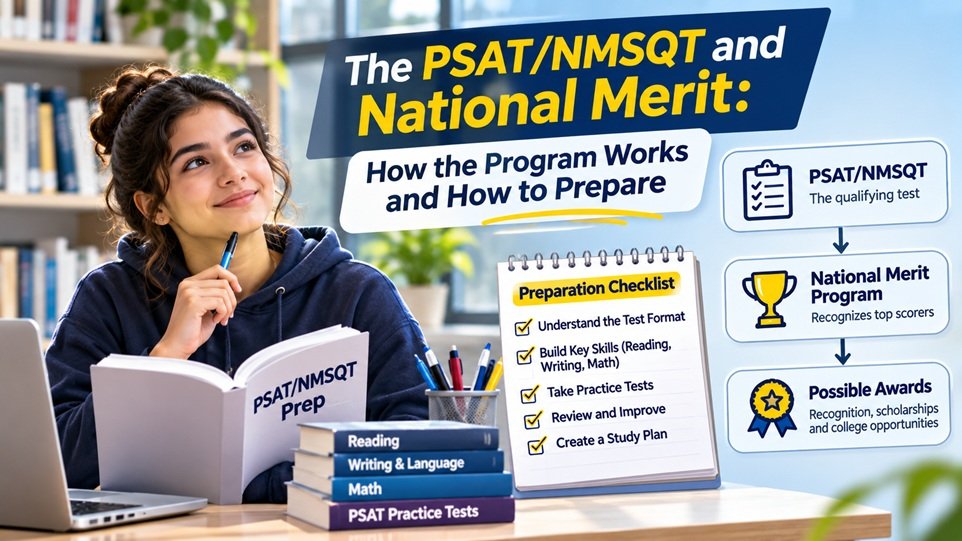
The PSAT/NMSQT and National Merit: How the Program Works and How to Prepare
The PSAT/NMSQT is often described as a practice SAT, but for high-scoring juniors it is also the entry point to the National Merit Scholarship Program. Understanding how the program works helps families decide how seriously to prepare and when to start.
What the PSAT/NMSQT Is
The PSAT/NMSQT is a digital test that high schools give each October. Like the SAT, it has two sections, Reading and Writing and Math, and it is adaptive by module: performance on the first module of each section sets the difficulty of the second. Scores range from 320 to 1520. Students can take it in 9th, 10th, or 11th grade, but only the junior-year test counts toward National Merit.
How National Merit Qualification Works
National Merit Scholarship Corporation (NMSC) does not use the total PSAT score. It uses a Selection Index, which doubles the Reading and Writing score, adds the Math score, and divides by 10. The range is 48 to 228. Because Reading and Writing counts twice, strong verbal skills carry extra weight.
- Commended Students: roughly 34,000 students nationwide who score above a national cutoff but below their state's Semifinalist level.
- Semifinalists: about 16,000 students, roughly the top 1% of juniors in each state. Cutoffs are set state by state, so the score needed depends on where a student attends school.
- Finalists: most Semifinalists who submit a complete application, including academic records, a school recommendation, and an essay, advance to Finalist standing.
Semifinalists are announced in September of senior year, and Finalists are announced in February.
Why State Cutoffs Matter
A Selection Index that qualifies a student in one state may fall short in another. States with large numbers of high-scoring students tend to have higher cutoffs. Families can review their state's recent cutoffs to set a realistic target. Cutoffs usually move only a point or two from year to year, so recent history is a reasonable guide.
How to Prepare
- Use the 10th-grade PSAT as a baseline. Compare the Selection Index with recent cutoffs in your state to see how far the student needs to move.
- Prepare in the summer before junior year. The PSAT/NMSQT is given in October, so summer is the main window for focused work.
- Practice in the digital format. The College Board's Bluebook app includes full-length PSAT and SAT practice tests that mirror the real testing interface.
- Prioritize Reading and Writing. Because of its double weight, steady gains in grammar, vocabulary in context, and reading comprehension pay off.
- Combine PSAT and SAT prep. The two tests share the same structure, so preparing for one directly supports the other. Many students take their first SAT soon after the October PSAT.
Families looking at how to prepare for the PSAT and National Merit in Colorado or any other state will get the most from their time by starting with a diagnostic practice test and an honest comparison against their state's recent cutoff.
Is It Worth the Effort?
National Merit recognition can lead to scholarships, and some colleges offer significant awards to Finalists. Students who fall short of the cutoff still gain a head start on SAT preparation, since the skills carry over. For students already scoring near their state's cutoff on the 10th-grade test, focused preparation before October of junior year is often worth it.