
How Can Nonprofits Increase Donor Engagement Without Expanding Their Physical Space?
Most nonprofits don’t have a space problem. They have an engagement design problem. When donor recognition depends on plaques, banquet seating, or whatever fits in the lobby, support eventually outgrows the format instead of strengthening the relationship.
In the U.S., that matters more than ever. The Fundraising Effectiveness Project reported that Q4 2024 dollars raised were up 3.5% over 2023, but donor counts fell 4.5% and retention rates declined 2.6%, which is a clear sign that many organizations are bringing in money while still losing participation and continuity. If you’re trying to keep more people connected to the mission, adding square footage is usually the expensive fix for the wrong problem.
Stop treating recognition like a wall problem
A physical donor board is fine for commemorating major gifts. It’s not a complete engagement system. Once names go on a wall and stay there, the experience becomes static for the donor and invisible to everyone who isn’t standing in that one hallway.
The better approach is to treat recognition as an ongoing communication channel. That means showing donors what happened, who joined the effort, what milestones were reached, and where their support is, making a difference across the year. When teams shift from “where do we put more names?” to “how do we keep supporters seeing themselves?”, the options open up quickly.
Build recognition into the channels donors already use
Most donor engagement now happens through screens people already check all day. Email, website, event displays, campaign landing pages, text follow-up, and social content can all reinforce appreciation without a need to find another blank wall in a building.
That doesn’t mean blasting everyone with public thanks. It means matching the recognition format to the donor relationship. Some supporters want public acknowledgment. Some want impact updates. Some want early access to campaign news, a note from leadership, or a short video from the program team. The practical move is preference-based recognition, not one-size-fits-all visibility.
Use a virtual donor wall where it actually helps
A virtual donor wall works well because it functions as a digital version of traditional recognition while allowing updates in real time rather than waiting for a contractor, replacement panel, or annual redesign. It can also display donor profiles, contribution details, and interactive elements that help visitors explore names, stories, and impact instead of just scanning a list.
That flexibility matters for organizations with limited room but have an active fundraising calendars. A healthcare foundation, school, museum, or nonprofit community can recognize campaign donors, monthly supporters, legacy commitments, and event sponsors in one place without cramming every constituency into the same physical installation. Done well, it also helps remote supporters feel included, which is a big deal when many donors will never walk into your building.
Show impact, not just names
This is where many recognition projects lose momentum. The display looks sharp on launch day, then turns into a prettier spreadsheet. Donors don’t stay engaged because their name appears on some page in the display. They stay engaged when the organization keeps connecting their support to visible results.
A stronger setup includes short impact stories, campaign milestones, beneficiary outcomes, program photos, rotating spotlights, and timely updates after major pushes like year-end appeals. If someone provides students with scholarships, food access, cancer support, or arts programming, they should see evidence that the work has been done towards the cause the donation was made. Recognition earns attention when it carries meaning.
Make digital donor recognition walls part of Management
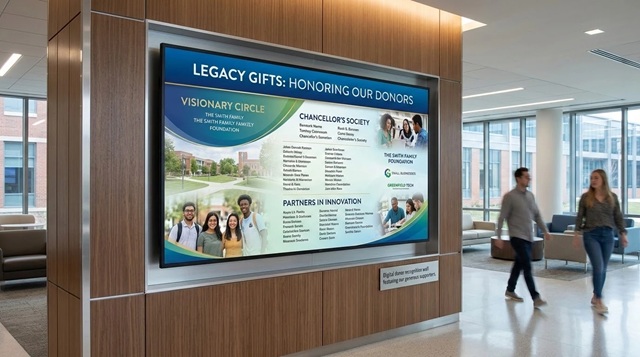
The best digital donor recognition walls are not standalone decoration. They work when they’re tied to management routines such as regular content updates, donor spotlights, multimedia storytelling, and integration with donor data so new gifts and milestones can be reflected without heavy manual work. Source material on these systems also emphasizes real-time updates, personalization, analytics, and connections to existing donor management tools, which is exactly why they can support engagement without demanding more physical space.
Operationally, this means someone owns the calendar. Someone approves the naming rules. Someone decides which stories rotate monthly. If no one owns that process, the screen becomes expensive wallpaper. That’s not a technology issue. That’s a management issue, and it’s fixable.
Create more touchpoints
Space constraints often expose a deeper problem, some nonprofits only “see” donors when they’re fundraising. If every visible touchpoint is tied to an ask, adding more displays won’t help much. You need more moments of useful contact between campaigns.
A practical cadence usually looks like this:
- A simple thank-you after the gift.
- A short update within 30 days.
- A public or semi-public recognition moment when appropriate.
- A mission-centered progress update later in the quarter.
- A personalized touch for donors with recurring or upgraded support.
That sequence is not just fancy. It works because it’s consistent. It also keeps the donor relationship moving even when your office, campus, sanctuary, clinic, or theater has no room for another physical installation.
Use events and common areas more intelligently
You don’t need a new wing to create presence. You need to get more mileage from the spaces you already control. A monitor at check-in, a lobby screen before a grand program, a looping donor spotlight before a board meeting, or a campaign display at a volunteer event can all extend recognition into moments when supporters are already paying attention.
This matters for mid-sized nonprofits especially. Many have one main building and a crowded fundraising calendar. Using portable or shared displays lets the organization adapt the message. Major donor dinner tonight, scholarship breakfast next week, community campaign update after that. Same hardware. Better use of it.
Measure whether engagement is actually improving
To measure donor engagement, focus on behavior rather than superficial compliments. While staff might hear that a recognition display "looks great," this feedback is not the actual metric. Instead, you should track concrete metrics like repeat giving, second-gift conversion, monthly donor growth, event return rates, email engagement from recognized segments, and response rates after stewardship touches.
That focus lines up with the broader U.S. fundraising environment. AFP’s Fundraising Effectiveness Project notes that nonprofits need growth-oriented strategies that both increase gains and reduce losses, and its reporting continues to show pressure on retention and donor participation even when total dollars rise. In plain terms, more money from fewer people is not a comfortable long-term plan for most organizations.
Keep the system manageable
The most effective recognition strategy is usually the one your team can maintain, not the one that looked impressive in a vendor demo. Start with a simple structure. Set recognition tiers. Decide what gets updated weekly, monthly, and quarterly. Pull content from campaigns you already run. Reuse event photos, donor-approved testimonials, and impact numbers that are already in board reports or annual fund materials.
And keep the donor experience clean. No endless animations. No fifteen-click navigation. No giant display full of names nobody can read from six feet away. The point is appreciation and connection, not a tech flex.
When nonprofits outgrow their walls, they usually don’t need more walls. They need a better system for showing donors that their support is visible, current, and connected to real work. That’s how engagement grows without a construction project.