
How to Apply Newton's Laws of Motion in Your Higher Physics Assignment - A Step-by-Step Guide
Here you will learn how to use Newton’s laws of motion in clear steps that strengthen your higher physics assignment. The guide shows you how to apply each law with simple examples, so you can solve problems accurately.
Are you preparing a Higher Physics assignment and want a topic that gives you a clear structure and reliable data? Newton's Laws of Motion help you focus on principles that you can test in simple steps. You work with laws that link to real movement, vehicle safety, and engineering design. This gives you accurate results that you can explain with confidence.
An MDPI study found that students who used Newton's Second Law in their projects improved the accuracy of their data analysis, thereby strengthening the quality of their final work. With a clear plan, you can use these laws to guide your research and present findings that support your arguments.
This guide, developed with advice from The Academic Papers UK, a leading assignment writing service in London, explains how you can apply Newton's Laws of Motion in your Higher Physics assignment in simple and practical steps.
Most Important Summaries:
- Newton's Laws of Motion provide a secure system because all of the laws have predictable consequences that facilitate capable analysis in your SQA Higher Physics assignment.
- Choosing a specific goal allows you to avoid broad concepts and concentrate your higher physics assignment on what is most important.
- Newton's Second Law is usually the most appropriate because the force's mass, and acceleration are easily measured through data collection.
- Graphs in higher assignments for physicists that demonstrate the relationship between acceleration and force are stronger and easier to understand.
- In a high-scoring Higher Physics assignment, you should draw a clear conclusion that connects your desired results and theory.
How to Apply Newton's Laws of Motion in Your Higher Physics Assignment?
Understanding Newton's Laws helps you work with rules that guide every stage of your advanced higher physics assignment. These laws provide you with a clear path to plan tests and explain motions with confidence. Here is how you can apply Newton’s Laws of Motion in your assignment on Higher Physics.
Choosing Your Topic and Aim
The topic of your Higher Physics assignment should be based on Newton's Laws. This ensures your assignment stays focused and outcome-driven. Many teacher-approved examples on the internet make your planning easier. A Taylor and Francis Online study reported that the students who identified clear linear relationships in their topics performed better with data handling. Newton's Laws support this trend by promoting consistent and constant research.
Avoid Weak Objectives
Many students lose marks because their objectives are too broad and unclear. A poor objective lacks technical direction and fails to grasp the essence of the concept. For example, the goal of studying Newton's Second Law is not informative. It does not clarify what you want to measure, but it should guide your research.
How to Write a Strong Aim
A clear purpose provides you with a guideline for your experiment and enhances your grades. But an example: To find out the dependence of acceleration on unbalanced force at constant mass. This mission is a quantifiable, direct goal related to the Second Law of Newton.
The Underlying Physics Section
This section forms the backbone of your higher physics assignment. It demonstrates your understanding of the principles behind your experiment. Teachers value depth and accuracy over repeated textbook definitions. Many students lose marks because they repeat textbook lines without justifying how the theory applies to the specific structure.
A ResearchGate study found that students who associated theory with their apparatus received higher scores than those who used generalised descriptions of it. The evidence suggests that straightforward relationships are more important than lengthy definitions. Newton's laws of motion are fundamental principles of physics that help in coursework writing by providing the theoretical basis and problem-solving framework.
Law 1: Newton’s First Law of Motion
Newton's First Law states that an object remains at rest or in uniform motion unless acted upon by a net external force.
Example Case: A cart stays still until you apply a pulling force. On a low-friction surface, it moves easily; on a high-friction surface, it slows down. The law explains why acceleration occurs only when the pulling force exceeds the frictional force.
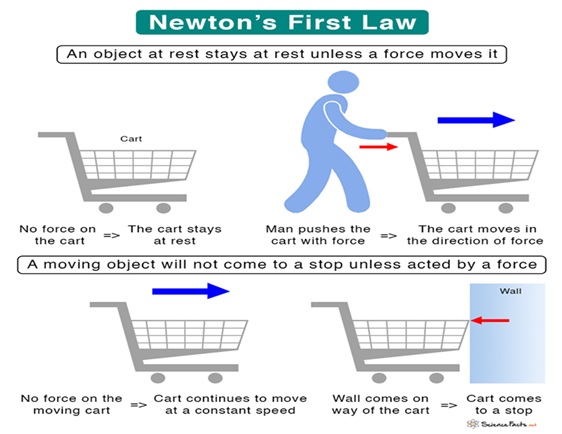
Source: Science fact
Law 2: Newton’s Second Law of Motion
The Second Law is that the force is equal to mass acceleration (F = ma). The acceleration accelerates in a form of direct proportional relationship to the force that acts on a given mass.
For example, increasing the weight of a trolley results in higher acceleration, provided that the force applied remains constant. A straight line just through the origin must appear in your graph and this is a clear indication of the law.

Source: Adobe stock
Law 3: Newton’s Third Law of Motion
The third Newton Law states that an action leads to a response or a corresponding action. For instance, the trolley exerts a downward force on the track, which in turn exerts an equal upward force on the trolley. The third law of Newton is explained in a given picture that explains the trolley scenario.

Source: Libretexts Physics
Data Collection and Method
Your method is one of the highest-scoring sections of your higher assignment in physics. It shows that your experiment is trustworthy and based on physics. The instructor would like to observe that every step you take aligns with Newton's Second Law.
ScienceDirect reported that a more precise definition of variables and the method enabled students to produce more consistent data and achieve better grades. This experience indicates that an accurate approach is not only beneficial; it is mandatory.
Equipment List
- Light gates
- Interrupt card
- Electronic balance
- Weights
- Pulley
- Trolley
- Runway or air track
The equipment accurately measures force and acceleration, making the setup simple and easy to replicate.
Measuring Variables
You need to state your variables clearly and in a systematic manner.
- Independent Variable: Lighting on the weights in the pulley.
- Dependent Variable: Speed, which is determined by light gates.
- Control Variable: Mass of the trolley and mass of the string system constant.
Data Analysis and Graphs
The data analysis section demonstrates your ability to deduce meaningful scientific conclusions from raw data. It also shows your ability to confidently and clearly connect your results to Newton's Second Law. One reason many students lose marks is that they don't follow instructions or show how they analyse their readings.
ResearchGate shows that students who explain each processing step produce stronger conclusions and demonstrate higher levels of scientific knowledge. This outcome indicates that a clear analysis is more important than readings.
Processing Your Data
You will measure several acceleration values for every force value during the experiment. Repetitive measurements help reduce random errors. The mean acceleration must be determined after the readings are ready because it will give a true pattern. The instructor will expect to see your formula and a well-organised presentation of your calculations. This data shows the validity and clarity of your calculations in your higher physics assignment marking scheme.
Plotting the Graph
Your graph is the visual centre of your analysis. The plot of force will be taken on the vertical axis and acceleration on the horizontal axis. If the mass is the same, the points will all lie on the origin. This data is the most compelling evidence that acceleration is directly proportional to force, thereby proving the Second Law of Newton.
Using Technology
Use physics software or Excel software to clean a graph and find the gradient in order to identify it precisely. This will improve the quality of your analysis and help you write down clear results.
Handling Uncertainties and Evaluation
A major component of getting outstanding grades on your higher physics assignment is handling uncertainties. Many students lose marks because they fail to relate their experiment to the uncertain results or ambiguous comments they make.
Evaluating Your Method
In the analysis part, you should outline the actual problems that could have influenced the validity of your experiment. There are many factors that affect the validity of your experiment, such as technical and human error.
A thorough assessment can lead to higher grades, as it reflects a true understanding of the material. In case you have a problem with this part, you can get higher physics assignment help from UK-based writers to obtain an example of the feedback and support.
Structuring the Final Report
Your final report layout greatly contributes to the quality of your understanding and the marking of your work. An outline makes it easy to keep the instructor with you throughout your line of reasoning and ensures that all necessary sections are included. Most students lose marks due to disorganised reports.
The simplicity and accuracy of your front page should be simple. It must include your name, your SQA number, and the name of your experiment. This small step improves the working environment and brings your work closer to SQA standards.
Structure Checklist
An effective Higher Physics assignment takes this order.
- The title and aim should be clearly defined and aligned with Newton's Second Law.
- The process of collecting raw data involves reading tables and gathering equipment information.
- Graphical Analysis involves processing values and creating a slope graph.
- The final statement should be aligned with the aim of the study.
- Include any strengths, weaknesses and opportunities for improvement.
- References refer to any sources you have used to support your understanding.
This facilitates the logical organisation of your work in a scientific manner that enables the instructor to realise your clarity with each section.
How Professional Homework Help Services Can Support With Higher Physics Assignments
Completing a Higher Physics assignment can be challenging, especially when applying Newton’s Laws. AI-free assignment writing services can explain theoretical concepts and present data effectively. They can offer examples of high-scoring assignments and help refine your aim and methodology.
Getting help from professionals helps you understand complex physics concepts better and ensures your assignment meets SQA standards. You gain insights into data analysis and proper uncertainty evaluation. This support improves your marks while strengthening your understanding, making it easier to apply Newton’s Laws confidently in future experiments.
Conclusion
Applying Newton's Laws of Motion to your Higher Physics assignment is much simpler when you follow a methodical approach. These laws make it simple to test specific patterns, and you might have developed a simple experiment that is easy to measure. You have a specific objective, and your work presents a sound scientific narrative.
Reasonable analysis and format will help the instructor know that you are getting the results and realise the limitations of your methodology. Applying the second law of Newton will enable you to produce a logical report, ensuring a high grade on your assignment. This guide will make the high physics assignment complete with confidence because you think better.
Frequently Asked Questions About Higher Physics Assignment
How Much is the Higher Physics Assignment Worth?
The Higher Physics assignment will normally carry 20 marks; that is, 20 per cent of your final mark. This means that your assignment will be as important as a full section of the exam. As a result, every section of your report needs to be precise, targeted, and organised. The instructor wants to see that you have a firm grasp of your theoretical aims when examining and analysing your results data. A well-written higher physics assignment can improve your overall grade, so you should make an effort to prepare and present each section carefully.
What is the Best Layout for the Physics Assignment?
The most suitable structure for a Higher Physics assignment is simple for the instructor to follow. Start with the title and goal, and then move on to the physics. The presentation of your analysis in the form of graphs follows the presentation of your methodology and raw data. The conclusion should relate to the goal, and your evaluation should highlight any shortcomings and potential areas for development. Add references at the end. This structure supports your work in a logical, scientific order and complies with SQA.