
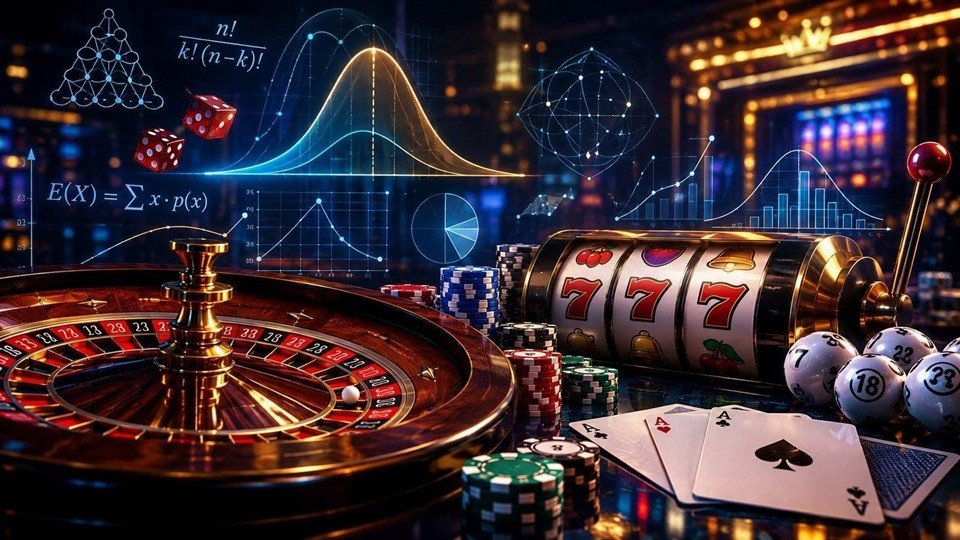
The Mathematics of Gambling: Why the Casino Always Wins
Gambling looks like a contest between luck and luck, but underneath the flashing lights is something much less mysterious: mathematics. Every properly designed gambling game has a probability structure that determines how much money is expected to return to players and how much remains with the operator. A player can win a particular spin, hand or ticket, sometimes spectacularly, while the game can still be profitable over a sufficiently large number of bets.
The Mathematical Advantage Behind Gambling
The central concept is expected value. If an outcome has a probability p and a corresponding net result x, its contribution to expected value is p × x. Adding those contributions for every possible outcome gives the average result that would emerge over an enormous number of repetitions.
For a casino game, the expected value is normally negative for the player and positive for the house. That difference is the house edge. If a game has a 4% house edge, a simplified interpretation is that the casino expects to retain about $4 for every $100 wagered in the long run. It does not mean that every player loses exactly 4%, or that the casino wins every individual round. Mathematics has no obligation to respect such convenient little stories.
Different forms of gambling create this advantage in different ways. In roulette, for example, the presence of zero or zeros gives the house an edge because the payout structure does not fully compensate players for the probability of winning. In blackjack, the edge depends on rules and strategy. In slots, the return is generally expressed as RTP (return to player). A theoretical RTP of 96% corresponds to a long-run expected return of $96 for every $100 wagered, leaving a theoretical 4% house edge.
From Lotteries to Slots: The Same Principle at Work
Lotteries use the same mathematical foundation, although the mechanism is different. Players buy combinations with extremely small probabilities of hitting the top prize, while the ticket price is greater than the statistical value of the prizes returned to the player population. The difference finances operator costs, taxes or public programs, depending on the lottery, and leaves the game with a built-in negative expected value for the average ticket.
Casino games usually operate on a much shorter feedback loop. A slot may produce thousands of outcomes during a session, while a lottery jackpot may require millions of tickets and many drawings before its largest prize is won. In both cases, however, the long-run relationship between probabilities and payouts determines the economics of the game.
Variance: Why Losing Can Look Like Winning
House edge alone does not explain what players actually experience. Variance describes how widely actual results can fluctuate around their mathematical expectation.
A low-variance game can produce frequent small wins and losses, making the results appear relatively stable. A high-variance slot may return nothing for many spins and then produce a large payout. Both games can have exactly the same RTP while creating completely different player experiences.
This is where the pool of winnings becomes important. A game does not need to distribute its theoretical return evenly. It can concentrate a substantial part of that return into relatively rare events. The resulting sequence of small losses, occasional wins and dramatic jackpots can create the impression that a big win is constantly "due", even though independent random events have no memory.
Variance changes the shape of the journey, while expected value determines where the journey tends to go over a very large number of bets.
Jackpots and the Mathematics of Rarity
Jackpots are the most visible example of variance. Their value can grow because the probability of winning is extremely small and because an accumulated prize can attract additional ticket sales. A jackpot therefore has two different mathematical questions attached to it: what is the probability of winning? and what is the expected value of a ticket?
Consider Powerball. Its jackpot odds are approximately 1 in 292.2 million, while its tickets cost $2. The record jackpot was $2.04 billion, won in California in November 2022. The official record and details are available from the largest lottery jackpot ever recorded by Powerball.
It is tempting to divide the jackpot by the number of possible combinations and declare the ticket suddenly profitable. That calculation is incomplete. A serious jackpot analysis must also account for lower-tier prizes, the cash value versus the advertised annuity value, taxes, the possibility of multiple jackpot winners and the share of ticket revenue that does not enter the prize pool.
When Can a Jackpot Become Mathematically Attractive?
The basic break-even idea is simple. Imagine a lottery with N equally likely jackpot combinations and a ticket price of C. If there were only one jackpot prize of J and no other costs or prizes, the jackpot component alone would reach a crude break-even point when:
J ≈ N × C
For Powerball's jackpot odds of roughly 1 in 292.2 million and a $2 ticket, that simplistic threshold would be about $584.4 million. But it is not a magic number at which the lottery automatically becomes a positive-EV investment. The real calculation needs the entire prize structure and the actual cash value of the jackpot. If several players can win the jackpot, the prize is split. If the advertised amount is an annuity rather than a cash payment, its present value is lower. Taxes can reduce the amount received still further.
There is another complication: once many people buy tickets, the assumption that a single ticket is uniquely positioned to win becomes less useful. More ticket sales increase the probability that someone wins, but they also increase the chance that the jackpot is shared. The mathematically interesting point is therefore not simply "How big is the jackpot?" but "What is the expected value of one additional ticket after every relevant adjustment?"
Why the Casino Can Lose Today and Still Win Tomorrow
A casino does not need every player to lose every session. In fact, that would be impossible for most games. Randomness guarantees that some players will experience large wins, while others will lose quickly. The operator's advantage emerges from aggregation: thousands or millions of independent wagers allow the statistical edge to become increasingly visible.
This is also why a lucky streak does not prove that a game has changed. A sequence of wins can occur naturally within a negative-expectation game. Likewise, a long losing streak does not necessarily mean that a win is "owed". Probability governs distributions, not individual destinies.
For readers interested in going deeper into house edge, expected value, gambling analytics and software used to examine casino mathematics, the website casinotip contains further mathematical explanations, analytical material and tools related to casino games.
Conclusion
The mathematics of gambling is ultimately a story about probability, expected value and variance. The house edge gives the operator a statistical advantage, while variance determines how dramatically actual results can depart from that expectation in the short term. Jackpots make the effect especially visible because a huge prize can accumulate while the probability of collecting it remains tiny.
A large jackpot can change the mathematical attractiveness of a lottery ticket, but only after the complete prize structure, cash value, taxes, split risk and ticket volume are considered. The useful lesson is not that every gamble is identical or that every player will lose. It is that the long-run economics of a gambling game are encoded in its probabilities and payouts long before the first wheel spins or the first reel stops.