
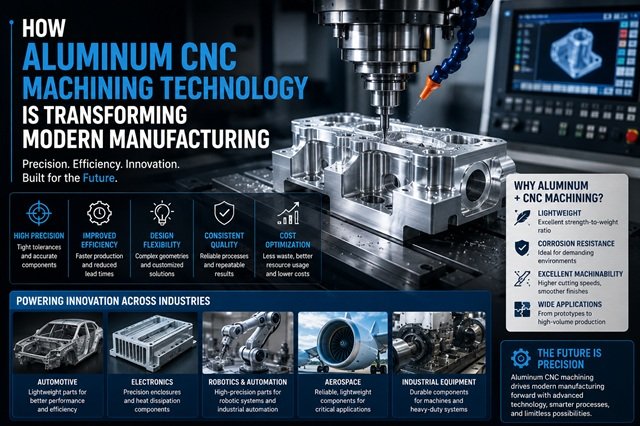
How Aluminum CNC Machining Technology Is Transforming Modern Manufacturing
Manufacturing has always evolved alongside technological progress. From traditional machining methods to advanced digital production systems, businesses continue to adopt new technologies to improve efficiency, accuracy, and competitiveness.
Today, companies across industries are looking for manufacturing solutions that can support faster product development, complex designs, and reliable production quality. Among these technologies, CNC machining has become one of the most important manufacturing processes for producing precision components.
Aluminum CNC machining, in particular, has gained significant attention because aluminum combines lightweight properties, excellent machinability, corrosion resistance, and strong mechanical performance. These advantages make aluminum an important material for industries including automotive, electronics, aerospace, robotics, and industrial equipment.
As manufacturing becomes more technology-driven, understanding CNC machining processes has become increasingly valuable for engineers, business managers, and companies involved in product development. Businesses selecting aluminum components often need professional knowledge about alloy selection, machining processes, and manufacturing considerations.
An aluminum CNC machining guide for material and process selection can help engineers and decision-makers better understand machining requirements before starting a manufacturing project.
The Growing Importance of Technology in Modern Manufacturing
Business technology is changing how companies design, manufacture, and manage products.
Traditional manufacturing often depended heavily on manual operations and individual experience. While skilled workers remain essential, modern manufacturers increasingly use digital technologies to improve consistency and production efficiency.
Today’s manufacturing environment integrates:
-
Computer-aided design (CAD)
-
Computer-aided manufacturing (CAM)
-
Automated CNC equipment
-
Digital production monitoring
-
Advanced quality inspection systems
-
Data-driven process optimization
These technologies allow manufacturers to transform digital designs into highly accurate physical components.
For businesses, this means shorter product development cycles, better quality control, and improved ability to respond to changing market requirements.
Why Aluminum Is Widely Used in CNC Manufacturing
Material selection plays an important role in manufacturing performance.
Aluminum has become one of the most commonly used materials for CNC machining because it provides an excellent balance between performance and cost.
Some major advantages of aluminum include:
Lightweight Performance
Compared with many metals, aluminum offers lower weight while maintaining sufficient strength. This makes it valuable for applications where reducing weight improves efficiency, such as transportation systems, electronics, and aerospace components.
Excellent Machinability
Aluminum is easier to machine compared with many harder materials. Its machinability allows CNC equipment to achieve faster cutting speeds while maintaining accurate dimensions.
This helps manufacturers reduce production time and improve cost efficiency.
Corrosion Resistance
Many aluminum alloys naturally form a protective oxide layer, providing good corrosion resistance. Additional finishing processes such as anodizing can further improve surface durability and appearance.
Design Flexibility
Modern CNC machining allows manufacturers to produce aluminum components with complex geometries, tight tolerances, and customized features.
Understanding the CNC Milling Process
CNC milling is one of the most important machining technologies used for aluminum components.
The process uses computer-controlled cutting tools to remove material from an aluminum workpiece according to a digital design.
A typical CNC milling workflow includes:
-
CAD model creation
-
CAM programming
-
Material preparation
-
CNC machining operations
-
Quality inspection
-
Surface finishing
Compared with traditional manual machining, CNC milling provides higher repeatability and allows manufacturers to produce complex components consistently.
Businesses requiring custom aluminum parts often rely on professional manufacturers with advanced CNC milling capabilities to support both prototype development and production requirements.
Companies such as Falcon MFG provide aluminum CNC machining solutions for industries requiring precision components and reliable manufacturing processes. Explore Falcon CNC milling guide for understanding modern machining processes.
How CNC Machining Supports Business Innovation
Manufacturing technology directly influences business competitiveness.
For product companies, the ability to quickly develop and manufacture components can determine how successfully they bring new products to market.
CNC machining supports business innovation by enabling:
Faster Prototyping
Engineers can quickly convert digital designs into physical prototypes. This allows companies to test, improve, and validate products before mass production.
Flexible Production
Unlike some traditional manufacturing methods that require expensive tooling, CNC machining provides flexibility for customized designs and different production volumes.
Consistent Quality
Computer-controlled machining processes help maintain dimensional accuracy and repeatability, which is especially important for industries requiring strict specifications.
Global Supply Chain Support
Modern manufacturers can work with international customers by providing reliable production capabilities, digital communication, and quality documentation.
The Role of Aluminum CNC Machining in Different Industries
Aluminum CNC machining is widely used across multiple sectors.
Automotive Industry
Automotive companies use aluminum components to reduce vehicle weight while maintaining performance. CNC machining is often applied for precision brackets, housings, structural components, and functional parts.
Electronics Manufacturing
Many electronic products require lightweight and durable aluminum enclosures, frames, and heat dissipation components.
Robotics and Automation
Robotic systems require precise mechanical components with excellent strength-to-weight ratios. Aluminum machining helps manufacturers create reliable robotic parts.
Aerospace Applications
The aerospace sector depends on lightweight materials and high precision. Aluminum alloys are commonly selected for aircraft components and supporting structures.
Future Trends in CNC Manufacturing Technology
The future of manufacturing will continue to be shaped by automation, digitalization, and intelligent production.
Several trends are expected to influence CNC machining:
Smart Manufacturing
Connected machines and digital systems will allow manufacturers to monitor production performance and optimize operations in real time.
Artificial Intelligence Applications
AI technologies are increasingly being used for production planning, quality analysis, and process improvement.
Sustainable Manufacturing
Businesses are paying more attention to energy efficiency, material optimization, and environmentally responsible production methods.
Advanced Material Applications
As industries continue to develop new products, manufacturers will need machining expertise for a wider range of materials and applications.
Choosing the Right Aluminum CNC Machining Partner
For businesses developing precision products, selecting the right manufacturing partner is an important decision.
A reliable CNC machining provider should offer:
-
Advanced machining equipment
-
Experienced engineering support
-
Strict quality control processes
-
Material expertise
-
Prototype-to-production capabilities
A strong manufacturing partner does not simply produce parts. They help businesses improve designs, reduce production risks, and achieve better product outcomes.
Conclusion
The future of manufacturing will be defined by the combination of advanced technology, engineering expertise, and data-driven decision-making. As businesses continue to face increasing demands for faster product development, higher precision, and more flexible production capabilities, CNC machining technologies will remain a key foundation of modern industrial growth.
Aluminum CNC machining represents more than just a production method. It is a strategic manufacturing solution that helps companies achieve lightweight designs, improved performance, and efficient production across different industries. From automotive components and electronic enclosures to robotics systems and industrial equipment, aluminum machined parts continue to support innovation in products that shape everyday life.
The development of smart manufacturing, automation, and digital production systems is also changing how companies approach manufacturing partnerships. Businesses are no longer only looking for suppliers that can produce components; they are seeking technology-driven partners that can provide engineering support, process optimization, quality assurance, and long-term production reliability.
Manufacturers that successfully integrate CNC technology with modern business practices will be better positioned to compete in a rapidly changing global market. By combining advanced equipment, skilled engineering teams, and continuous improvement strategies, companies can reduce production challenges while creating higher-value products.
As industries continue to evolve, understanding manufacturing technologies such as CNC milling and aluminum machining will become increasingly important for engineers, product developers, and business decision-makers. Companies that invest in the right manufacturing knowledge and partnerships will have greater opportunities to improve efficiency, accelerate innovation, and build stronger competitive advantages in the future.