
Support Worker Injury on Common Property: Who is Liable?
Where a support worker sustains injuries on common property (hallways, foyers, lifts, stairs, shared driveways), no single party is automatically at fault. It depends on what caused the injury, whether the risk was controlled, and which party had a reasonable burden to prevent the injury.
In practice, in most real-life situations, the employer provides short-term assistance to the employee through workers' compensation (or a similar work-injury program), since the injury occurred during work.
However, the ultimate question of who pays is often argued afterward—particularly when:
- The injury resulted from a hazard on common property (poor lighting, broken stair nosing, slippery tiles).
- The accident was caused by someone's action (e.g., a spill on the floor with no warning signs).
- Maintenance was postponed or overlooked.
This is why such cases usually have more than one layer: first, workplace injury coverage; and second, liability issues concerning negligence and insurance.
Identifying the Parties Involved in an Injury Claim
It helps to distinguish the people involved from the legal roles, as they do not always coincide. Common parties include:
The worker (injured person)
They have rights under workplace injury systems as well as independent claims in the event of negligence.
The provider/employer
The organization that employs or contracts the worker. Training, safe work procedures, and equipment are often their responsibility (e.g., non-slip footwear policies, manual handling training, and incident reporting).
The resident/client (the individual receiving care)
May be engaged when their actions posed a risk (e.g., asking someone to carry unusually heavy objects up unsafe stairs, or leaving personal property in a common walkway).
The building management/scheme (the party in charge of common areas)
Normally tasked with the maintenance and repair of common property—and with reasonable efforts to manage known risks.
What is Common Property? Understanding Control and Responsibility
Common property generally consists of common areas used by various residents and visitors, such as entrances, corridors, lifts, staircases, gardens, car parks, and bin rooms.
This is important because the individual or organization that controls the area is normally the one supposed to oversee the associated risks. In other words: control and responsibility tend to go hand in hand.
If the injury happened:
- Within the lot: Analysis of incidents within the resident's unit often focuses on the duties of the resident/occupier.
- In a shared area: Analysis usually shifts to the common-area management and maintenance responsibilities of the building.
In-Home Support Services: Managing Risks in Shared Areas
Staff members who offer in-home support services may traverse various risk areas on a given visit, such as parking lots, ramps, lobby areas, lifts, corridors, and finally the unit—all while carrying supplies or assisting a person with mobility.
The fact that the job is mobile and time-sensitive means that a minor risk can be magnified to an extreme (a slippery tile outside the door, a broken handrail on the path to the lift, insufficient light on a stair landing).
Practically, this translates to the fact that an incident could entail a number of contributory factors simultaneously: the conditions of the building, the safety systems of the provider, and the realities of efficient care delivery.
Determining Liability: Duty of Care, Breach, and Causation
The questions of liability usually reduce to several concepts (although the specific legal formula may depend on the jurisdiction):
Duty of care: Was there a duty to make the area reasonably safe?
There is a possibility of various parties having concurrent duties. A building controller can have a duty to maintain common areas in a safe condition, whereas an employer has a duty to maintain safe systems of work.
Breach: Did the party fail to act reasonably?
Some examples of reasonable steps may include:
- Repairing a known defect within a sensible time.
- Placing warning signs following mopping.
- Installing lighting in common stairwells.
- Staff training on not rushing, identifying hazards, and reporting accidents.
Causation: Did the injury actually result from that failure?
There can be a hazard but no injury. The most important issue is whether the particular violation caused the occurrence.
Evidence: Can it be proved?
Here the practicalities are to be considered:
- Pictures of the location (lighting, floor, handrails).
- CCTV footage (if available).
- Maintenance records and records of previous complaints.
- Witness reports and incident reports.
The Role of Strata Body Corporate in Injury Claims
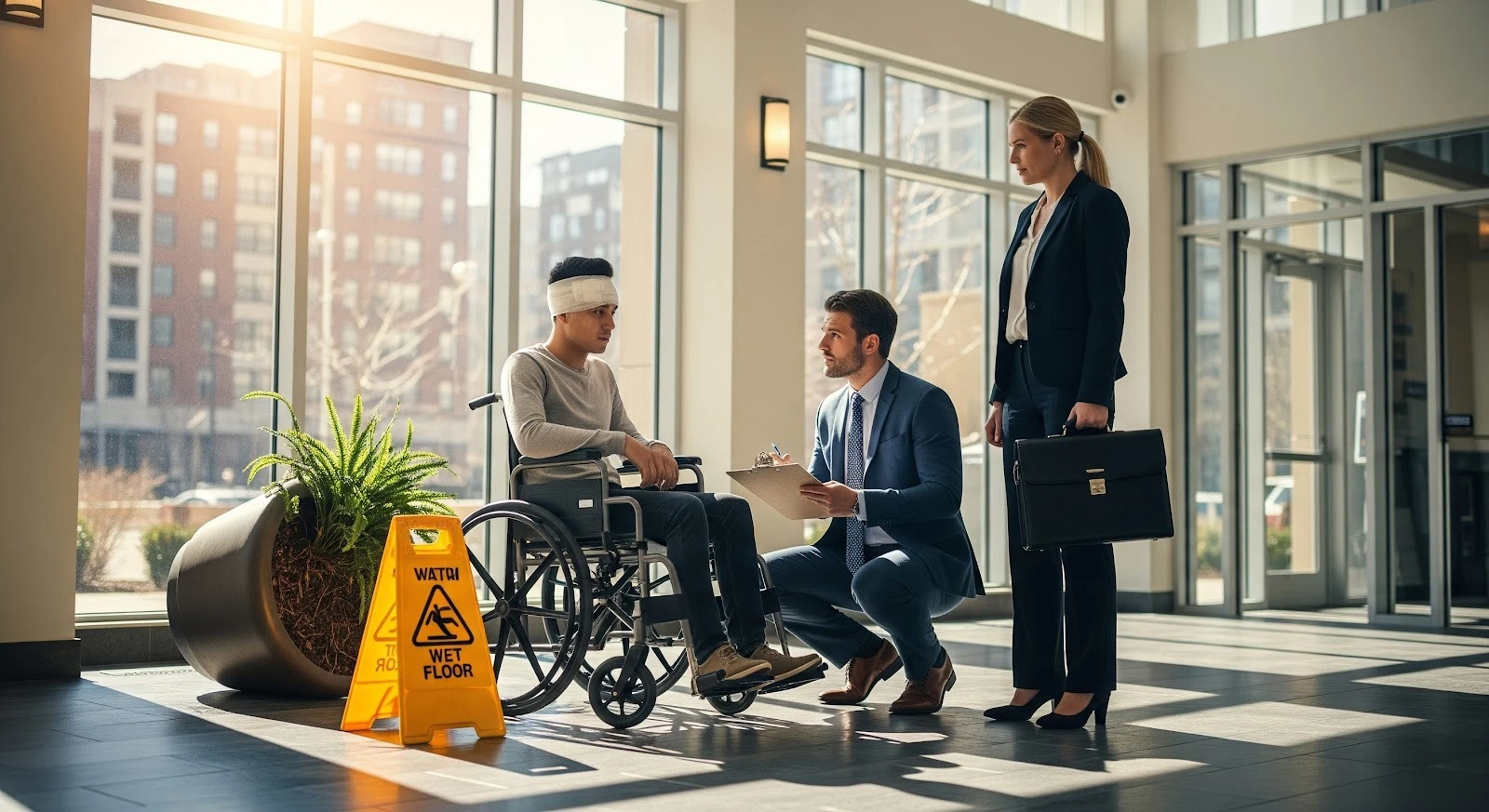
In most strata-type buildings, the body corporate that administers and maintains common property is the strata body corporate (also known as an owners corporation in some jurisdictions), which is normally financed by levies and managed by committees and/or a strata manager.
Since it controls the common areas, it is often the center of questions such as: Are repairs done correctly? Have hazards been addressed in a timely manner? Have contractors been managed professionally?
More importantly, it usually holds the relevant insurance for common grounds; therefore, even if fault is disputed, the insurance channel may influence the speed of settlement.
Post-Injury Checklist: Immediate Steps to Take
Speed and documentation are important when an injury has taken place. These measures can assist in safeguarding the interests of all people (including the health of the injured employee):
- Seek medical attention first (even if the injury seems minor).
- Immediately report the incident to:
- The employer/provider (for workplace reporting).
- Building management (to log the hazard on the property side).
- Record pictures/video of the place and the hazard (as well as lighting conditions where applicable).
- Identify witnesses and obtain contact details.
- Inquire about CCTV and ask that footage be preserved immediately (retention times are often short).
- Make the risk safe (signs, protection, repair order).
Risk Management: Preventing Injuries for Providers and Residents
An injury prevention attitude reduces the likelihood of injuries and simplifies the process of addressing conflicts impartially should an injury occur.
For providers/employers
- Educate and train personnel on their authority to stop work: if a situation appears unsafe, staff members should stop and report it.
- Simple process (single form, snap photo, single point of contact).
- Review patterns: Escalate when more than one worker reports a hazard (e.g., a slippery entrance).
For residents/clients
- Maintain access points (outside the unit door).
- Request that the provider describe a safe arrival setup (parking, lift access, safe drop-off points).
- Reporting hazards creates precautions and prevents accidents before they occur.
For building management/committees
- Document hazard reports like safety tickets: record them, screen them, and attach evidence.
- Keep maintenance books in order (they are essential when there is a dispute over liability).
- Make contractors adhere to simple measures (signs and barriers, safe working procedures).
Conclusion: Navigating Support Worker Injury Claims
When a support worker is injured on common property, the most important question is not "Who is liable?" but "Who controlled the risk, who knew (or ought to have known), and what reasonable measures had (or had not) been taken?"
That is usually sorted by a close inspection of the location, maintenance history, evidence of previous incidents, and the working arrangement between the provider and the resident.
If such a scenario is currently in progress, a brief legal consultation is useful to explain the most robust course of action: workers' compensation, an insurance claim, or a negligence claim (or both).